Wednesday, April 11, 2012

"Well did you bring enough to share?"
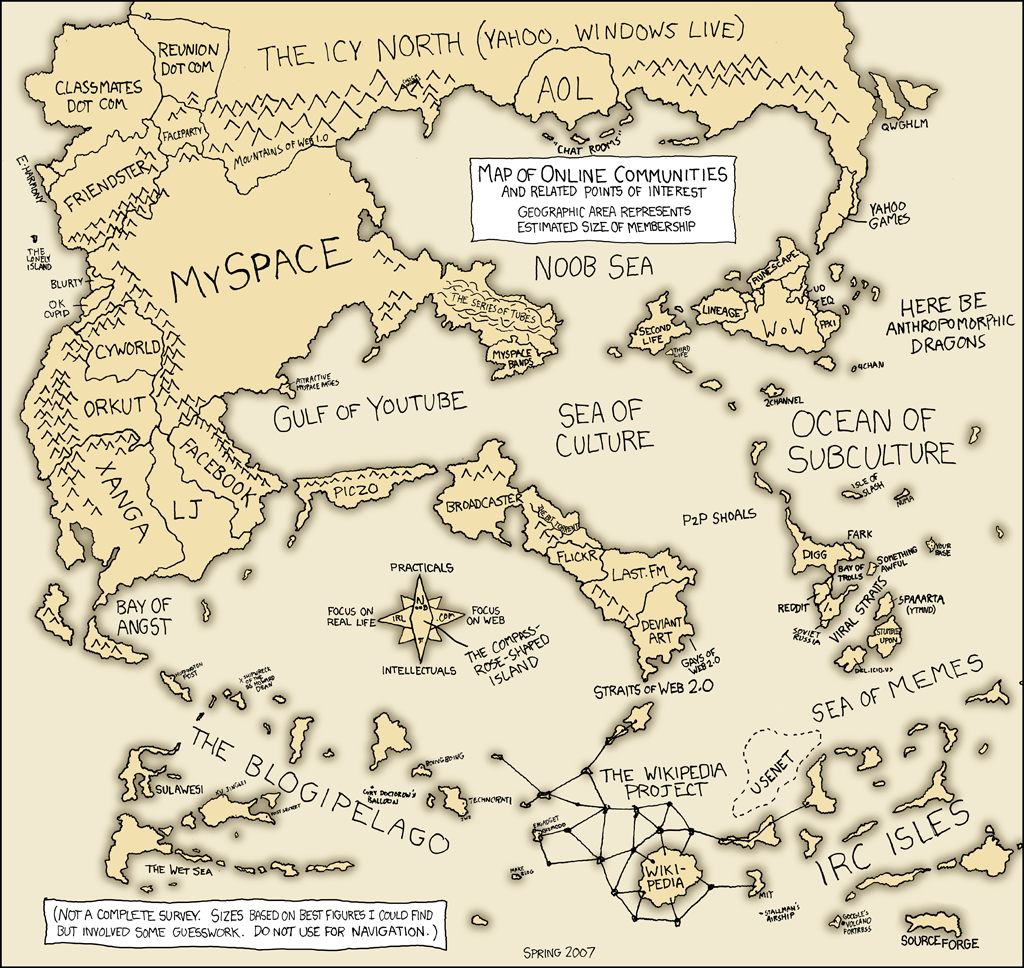
I read about you. At least, I could have read about you. After reading your bio on Facebook, I wandered to Wikipedia to read about everything you said you were interested in. I checked your friends, I looked at their pictures, viewed their links, read their resumes, met their family too. I didn’t pay for that information, you told me what to look up. I didn’t pay for the encyclopedia I used either. Some massive community joined in league and decided to create a repository of all things. I’m not even paying for the software I’m using. It’s “people’s software” and if everyone made it, who owns it? No one. Who owns the information? The list of friends? Everyone does. Mass collaboration changes everything. Humanity loves to connect with itself and technology gives it power to extend beyond any barrier that has kept it unconnected in the past. This changes how we act, who we’re friends with, everything changes. Since technology has allowed us to interact on such a broad scale, so many people have joined the conversation—and project.Wikinomics, a book about mass collaboration, describes in fantastic detail the benefits and potential harms of having a conversation this big.
Generations today are MUCH different than the generations in the near past. We grew up with video games and computers—they are a way of life. We are the Net-Generation. We have made the world flat. Many of us don’t know how we got here. It’s just always been how things are. Children are more likely to recognize the red-angry-bird than Jesus. This is because everyone has helped to make information available. The Apache server, SQL data base, Linux, PHP (sometimes referred to as “LAMP”) dropped so many barriers that kept people from join conversations and projects and set a new precedence for collaboration. And the result? Google, Facebook, AOL, eBay, MySpace, LinkedIn, pretty much, everything that connects people to people or people to information, is a result of humanity wanting to connect and share. This new lifestyle has positives and negatives—security sacrificed for connectivity, everyone is now more transparent and exposed than ever—the progress that came; however far outweighed the bad.
"Well did you bring enough to share?"
I read about you. At least, I could have read about you. After reading your bio on Facebook, I wandered to Wikipedia to read about everything you said you were interested in. I checked your friends, I looked at their pictures, viewed their links, read their resumes, met their family too. I didn’t pay for that information, you told me what to look up. I didn’t pay for the encyclopedia I used either. Some massive community joined in league and decided to create a repository of all things. I’m not even paying for the software I’m using. It’s “people’s software” and if everyone made it, who owns it? No one. Who owns the information? The list of friends? Everyone does. Mass collaboration changes everything. Humanity loves to connect with itself and technology gives it power to extend beyond any barrier that has kept it unconnected in the past. This changes how we act, who we’re friends with, everything changes. Since technology has allowed us to interact on such a broad scale, so many people have joined the conversation—and project.Wikinomics, a book about mass collaboration, describes in fantastic detail the benefits and potential harms of having a conversation this big.
Generations today are MUCH different than the generations in the near past. We grew up with video games and computers—they are a way of life. We are the Net-Generation. We have made the world flat. Many of us don’t know how we got here. It’s just always been how things are. Children are more likely to recognize the red-angry-bird than Jesus. This is because everyone has helped to make information available. The Apache server, SQL data base, Linux, PHP (sometimes referred to as “LAMP”) dropped so many barriers that kept people from join conversations and projects and set a new precedence for collaboration. And the result? Google, Facebook, AOL, eBay, MySpace, LinkedIn, pretty much, everything that connects people to people or people to information, is a result of humanity wanting to connect and share. This new lifestyle has positives and negatives—security sacrificed for connectivity, everyone is now more transparent and exposed than ever—the progress that came; however far outweighed the bad.
Tuesday, April 3, 2012
Follow up on last post
Sunday, April 1, 2012
Let me stop you right there...you spent MONEY on that?


People spend real money to buy fake money! Not only that, but they waste time that they could have spent making money, to use whatever they bought with the fake money! As much as I love technology, I hate it when technology tries to get the best of me. Game theory is a great example. There are a lot of aspects to it, but essentially, game theory is used to get users to feel a need to either remain somewhere or do something. Prime examples are second life, Farmville, mafia wars, the Sims, etc. Zynga is the biggest company out there that creates apps for Facebook, and it blows my mind that the majority of its revenue comes from an online economy. As in people buy gold (or whatever) within a game using real money. I just find it so sad (borderline pathetic) when people turn their potential off and start investing in unproductivity. To reference and earlier post, I feel that unproductivity is the greatest threat that the internet has to offer. If we are not willing to take a step back and see technology (particularly the internet) for what it really is, as a tool to help us accomplish, then we are doomed as a society. As the wise man tells us: “do not spend money on that which is of no worth.”
Thursday, March 15, 2012
Wait, where are all the chicks?
Every so often, my wife visits me on campus. She usually tracks me down in a lab and proceeds to tell me about some weirdo she saw on her way in. In each class I have taken, there has never been less than a five-to-one ratio of guys to girls. As I've thought about causes, my explanations are either the girls just don’t like being around such weird guys; or, the guys are weird because there’s such little feminine presence. After more study, I was introduced to some more practical, better thought out ideas. So I conclude that there is a stigma of ‘nerdiness’ attached to the Computer Science major. After telling people my major, girls will sometimes politely attempt to explain their mental image that may look something like this. Granted, it's largely speculation, but I believe that current culture plays a huge part in why girls will more often choose nursing, biology, or even math, rather than Computer Science, and it will take even more time (and a few more issues of GQ) before society welcomes Computer Science as a smart major, socially .

Tuesday, March 6, 2012
The more they force me to do, the less I care to do it.

The founding fathers had great ideas, and it’s maddening to see those wholesome ideas abused. Granted, the founding fathers weren’t directly behind some things like copyright and patent laws, but the same idea holds that good, virtuous principles were made into helpful laws and now we see them benefit mostly the behemoths , and hurt the common-folk. The fact that someone can file for a patent, with no intention of ever actually creating anything makes me crazy. I knew someone who (true story) owned a failing tech business and out of desperation, rallied his employees together to brainstorm inventions or ideas that he could patent, then get money from lawsuits for infringement. I hate to follow the typical cliché of Robin Hood, if there is an apparent abuse of power by leadership, I have no qualms disregarding their expectations. The more I hear about the abuse of power by large companies, especially in the media industry, the less inclined I am to watch/listen to their content by paying for it myself. Patent law and copy right were designed to protect the innovator; however, those same laws have turned around to damn inventors, and line the pockets of the already rich. Something needs to change.